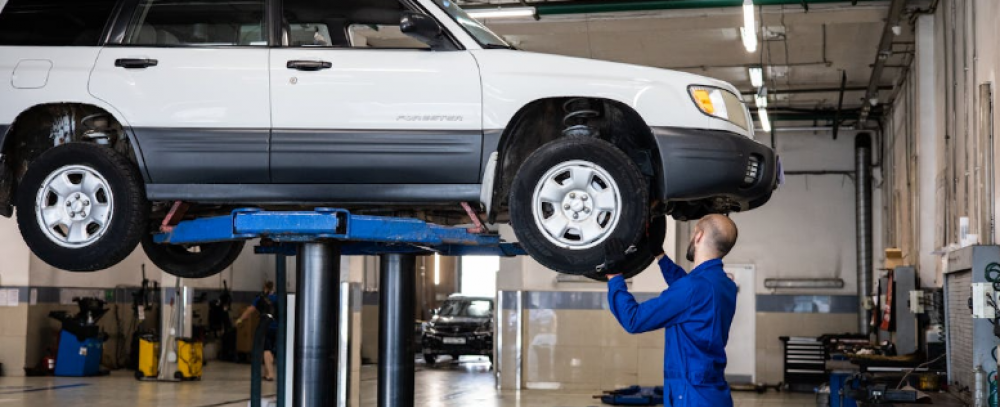
Want to get more cars through your shop every day?
Every shop owner wants to get more billable hours out of the same 8-hour day. Faster repairs mean:
- More jobs per bay
- Higher monthly revenue
Here's the problem:
The majority of shops are hemorrhaging minutes on old equipment. If the lift is slow, the bay is slow. And if the bay is slow, the whole shop gets left behind.
Without the right gear, you can't compete.
This article shows how much real time a drive-on vehicle lift can save on every repair.
Let's jump in!
Here's what's inside:
- Why Workshop Equipment Actually Matters
- How a Drive-On Vehicle Lift Saves Time
- The Supporting Equipment That Multiplies Savings
- Safety & Certification You Can't Ignore
Why Workshop Equipment Actually Matters
The difference between a thriving shop and a shop that's just surviving is the right equipment.
Why? Because every minute a technician is struggling with slow equipment is a minute not spent working on a car. And technicians time is the bottom line. Consider that industry research has found that adding just 30 minutes of productivity per technician per day, on a $100/hr billing rate results in $3,300 in gross revenue over a 22 day working month.
Let that sink in.
Faster equipment = More billable hours = More money.
Most auto repair shops have fewer than 10 bays. Every bay needs to count. If one bay is bogged down by a slow lift, total shop throughput suffers.
It makes sense, right? Upgrading workshop equipment is one of the quickest ways to:
- Cut time per job
- Increase daily car count
- Grow monthly revenue
How a Drive-On Vehicle Lift Saves Time
Of all the equipment in a modern shop, this one item has the most influence on turn around time. A drive-on vehicle lift eliminates the tedious setup work that lags technicians down on a conventional two-post lift.
No more:
- Positioning lift arms
- Adjusting pad heights
- Double-checking contact points
Driver drives vehicle up on ramps, applies parking brake and presses up button. Thinking about setting up a professional lift in your shop? It's the quickest method, hands down, for routine maintenance and repairs such as:
- Oil changes
- Tire rotations
- Brake inspections
- Exhaust work
- Alignments
A drive-on vehicle lift saves about 2-3 minutes on the setup of every job. That doesn't sound like much... Until you do the math on 15 jobs per day, 5 days a week. You've just gained over 2 hours of billable time per week.
Tip: Drive-on lifts, also known as four-post lifts, are particularly helpful when aligning and lifting long-wheelbase trucks, as the vehicle is supported by its own suspension. No time lost with adapters or lift points.
The Supporting Equipment That Multiplies Savings
The drive-on vehicle lift is the foundation... But it's not the whole story.
The Why: Your lift can only go as fast as the rest of your shop. If your tech is running back and forth to get tools, air, parts you are wasting the time you just gained. The shops that pull the best numbers have their whole bay built for speed.
Here are the biggest time-saving add-ons to pair with a drive-on vehicle lift:
Rolling Air Jacks
Rolling air jacks fit between runways and allow technicians to jack the wheels off the runway without rebounding the vehicle back down. This can save a tremendous amount of time on:
- Brake jobs
- Tire work
- Suspension checks
No more jacking the car down, moving to a two-post and then jacking back up. It's one continuous flow.
A Proper Air Compressor Setup
This is the one most shops get wrong.
Losing minutes on every lug nut if the air pressure drops every time another tech grabs an impact gun. Rotary compressor with line drops at each workstation keeps every tool running at full capacity.
Shop Management Software
A digital workflow with inspection system is a MUST for the repair shop. Shops with a digital workflow experience an average increase in repair order value of over $100 with no additional labor. Pure upside.
Safety & Certification You Can't Ignore
Here's something that a majority of retailers forget about when shopping for a drive-on vehicle lift...
Lifts don't all come certified. And an uncertified lift is not just a safety issue, it's a business issue. If the wrong inspector walks in the shop and spots an uncertified lift, you could be facing a red-tag shutdown.
The gold standard is ALI certification. Lifts with the ALI Gold Label have been overloaded to 150% of capacity in testing, and their hydraulics, locks, and electrical systems are all tested by independent labs.
Why does this matter for time savings?
- Certified lifts have fewer breakdowns
- Technicians work more confidently
- You avoid downtime from failed inspections
The International Building Code and OSHA rules mandate each lift in the shop to meet the ANSI/ALI ALCTV standard. Don't let the certification process slip through the cracks.
Pro tip: Every lift installed in the U.S. and Canada must be inspected at least once a year by a qualified inspector.
Pick the Right Lift for the Job
Not every shop needs the same lift. Before buying, take a look at:
- The types of vehicles in the shop (cars, trucks, EVs)
- The height of the shop ceiling
- The width of the bay
- The weight capacity required
A drive-on vehicle lift that is rated for 14,000lb will easily accommodate most light-duty trucks and SUVs. If the shop services larger trucks, then a greater capacity should be considered.
Purchasing the incorrect capacity is the single biggest error made by shop owners buying their first lift. Don't make that mistake.
Final Thoughts
Now you have a better idea of how the proper workshop equipment, like a drive-on vehicle lift, can save actual minutes on each repair.
Reduced repair times are not achieved by over-working techs. It's achieved by providing them with the right tools:
- A solid lift that's quick to set up
- Supporting equipment that keeps tools running
- Certification you can actually trust
Don't have the budget for a full upgrade right now?
Start with the lift. The return on investment on a drive-on vehicle lift is in months, not years. Just do the math:
- 2 extra minutes saved per setup
- 15 jobs per day
- 22 working days per month
That's about 11 hours of billable time that can be reclaimed each month, just from one device.
But remember... Before spending any money on a new lift, confirm the shop has the necessary installation parameters (ceiling height, floor thickness, power supply). The best lift in the world is no use if it doesn't fit in the bay


