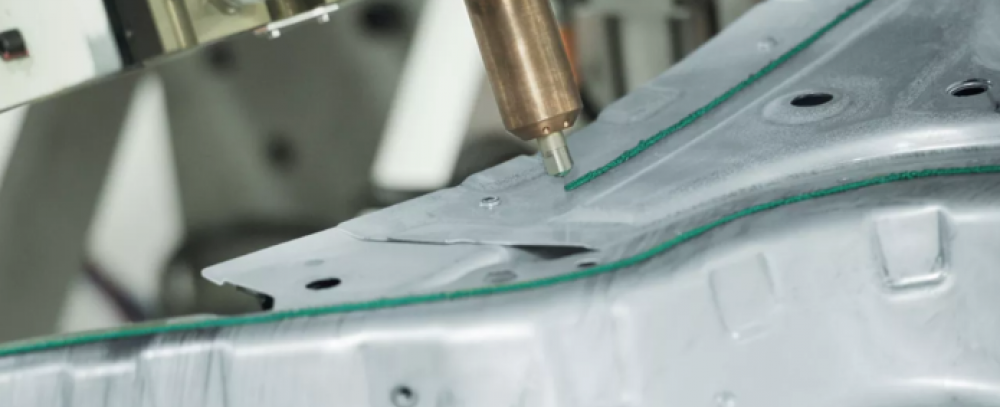
How is your vehicle put together? Specifically, what’s holding it together? Hopefully, you’re not driving around in a 1979 Buick LeSabre held together by duct tape and hope. But if you’re like most people, you’re probably not sure how your vehicle is held together.
And that’s OK! You’re not an automaker, so it’s not your job to know. If you had to guess, perhaps you’d venture that your vehicle is welded together. And in days gone by, you’d almost certainty be right. But today? Not so much.
Welding, structural adhesives, and auto repairTraditional welding is no longer the dominant method for building a vehicle body and joining it together. Increasingly, structural adhesives are just as––if not more––important to how automakers build their products. Manufacturers increasingly use adhesives such as epoxy, polyurethane, and acrylic either as replacements for welding or alongside it.
This isn’t just a neat fact to bring up at a backyard cookout or cocktail party. This shift affects how automobiles are built, how they perform in crashes, and how they’re repaired afterward.
What are structural adhesives?
Structural adhesives are high-performance bonding materials for transferring significant, continuous loads. They’re frequently used in service environments, offering exceptional load-bearing capabilities and often outperforming conventional fastening methods, such as mechanical fasteners, like screws, rivets, and bolts, or thermal joining methods, e.g.: welding.
Key benefits of structural adhesives
Structural adhesives evenly distribute mechanical stress, improve crash safety, and enable the use of lightweight, dissimilar materials such as aluminum and carbon fibre.
- Stress distribution: Screws or spot welds concentrate stress on specific points, whereas structural adhesives distribute loads evenly across the entire bonded surface.
- Material versatility: Adhesives can bond dissimilar materials, like carbon fibre to aluminum. Welding or drilling for similar tasks is often risky or even impossible.
- Integrity and appearance: Adhesives don't require holes, so they preserve material integrity, prevent corrosion, and leave a smooth, unblemished surface––when applied correctly.
- Stability: They provide remarkable resistance to chemicals, moisture, and changing temperatures.
Common Types of Structural Adhesives
There are numerous types of structural adhesives, and not all are used widely in automotive construction. Some of the more popular adhesives include:
- Epoxies.
- Acrylics.
- Poluurethanes.
- Cyanoacrylates.
Are adhesives stronger or weaker than welding?
This is a common question to ask, but it starts from a false position. The fact is, there’s no single metric that defines strength. For peel or tensile stress across a wide surface, adhesives can outperform welds. For concentrated point loads, welds typically win. This is why the industry trend is toward hybrid bonding, using adhesives and welds (or rivets) together to get the benefits of both.
So while there have been some high-profile stories of structural adhesives failing in real-world conditions, these are cases of using the wrong adhesive or applying it poorly. Just as not all weld jobs are equal, neither are all uses of structural adhesive. When done properly, either method can protect you in a vehicular collision. What’s important to note is which method(s) were used in the building of your vehicle, as this has major implications for the subsequent collision repair.
What this means for auto repair
The bonding methods used on the assembly line affect performance, safety, and what happens during collision repair. As structural adhesives have become standard in modern vehicle construction, the auto repair process has grown significantly more complex.
With a weld, a collision repair tech can grind it down and re-weld it. However, structural adhesives present a unique challenge. Once a bonded joint is damaged or compromised, it’s exceedingly difficult to restore it properly without fully separating the affected panels. This can require disassembling large sections of the vehicle, which adds time, labour, and cost to what might otherwise seem like a straightforward auto repair. It also means that the visible damage on the outside of your vehicle may not tell the whole story.
To make things more complicated, not all structural adhesives are the same. Different automakers specify different products for different joints. As GM's lead service engineer has noted, “glue doesn't tell you what it is or how to fix it.” Individual parts may have model or serial numbers engraved on them, or are otherwise visually identifiable to auto repair professionals. But adhesives? Not so much.
Without proper training and access to OEM repair documentation, a technician has no way of knowing what was originally used or how to replicate it correctly. Substituting the wrong adhesive, or skipping it altogether in favor of a weld, can undermine the structural integrity of your vehicle.
The right repairs for the right constructions
This is why choosing the right auto repair shop matters as much as the repair itself. Skilled collision repair technicians follow vehicle-specific OEM procedures that spell out exactly which joining methods and adhesives are required for each repair. And these aren’t just suggestions, they’re requirements for restoring the vehicle to its pre-collision condition.
An auto repair shop that cuts corners on these specifications may produce a repair that looks flawless on the surface while leaving your vehicle less capable of protecting you in a future crash. For drivers, the takeaway is simple: After any collision, ask the auto body technicians if they follow OEM repair standards. Your vehicle was built with precision. It deserves to be fixed that way, too.


