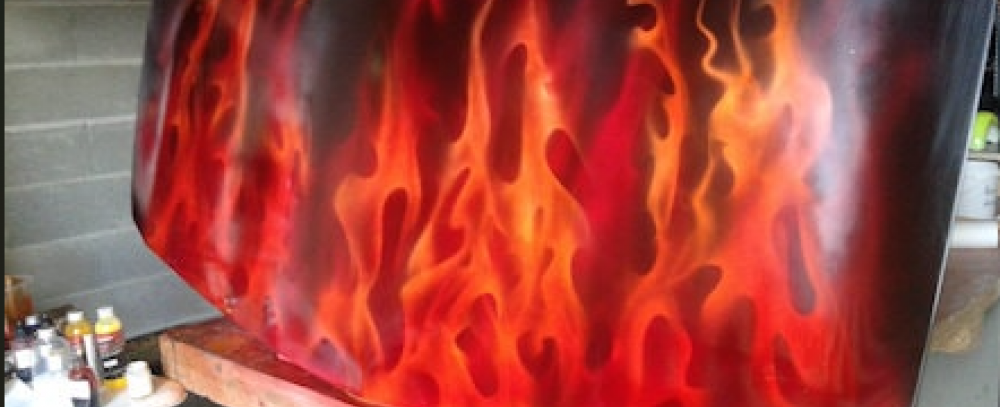
Flame painting is one of the main themes of custom paintwork. This art form emerged in California after the 1950s. There are different types of flames, both realistic and graphic, and I thought it would be very interesting to write this article about flame-painting techniques for vehicle bodywork.
The Potential of Custom Car Paintwork
Alongside the spray gun, the airbrush is one of the favourite tools used by automotive painters to personalize car paint.
An airbrush resembles a metal pen in both shape and size. In reality, it is a far more sophisticated and remarkable tool. It is a miniature spray gun fitted with a nozzle and needle measuring only fractions of a millimetre. It is easy to handle and allows artists to draw or paint small areas. However, it requires considerable training and practice to master the art of airbrush painting.
In the toolkit of the custom painter—whether working on motorcycles, bicycles, helmets, lorries or cars—the spray gun is essential, but the airbrush is often the star of the show.
Basic Concepts of Airbrush Colours for car paint
Before expressing artistic talent, it is essential to follow the basic rules of automotive painting, including the application of primer, adherence to technical instructions, and the final clear coat.
Whether painting a bicycle, helmet or motorcycle fuel tank, flame designs—or any decorative artwork—must be applied to a properly prepared surface: degreased, dust-free, dry, sanded and primed. Once these foundations are in place, creativity can take over.
After completing the artwork or freehand design, it should be protected with a two-pack finishing lacquer to guard against UV rays, weathering, corrosion and even petrol spills.
Which Paint Should Be Used for Custom Flame Designs?
For bodywork artwork, UV-resistant colours should always be used. Although UV-resistant clear coats exist, they cannot fully protect colours that are not themselves UV resistant.
Both water-based airbrush paints and solvent-based automotive paints can be used. Today, many water-based airbrush colours are specifically designed for automotive applications and can be clear-coated with solvent-based polyurethane lacquer for excellent durability.
Custom flame designs often combine opaque colours with transparent colours such as Candy paints. Graphic flame artwork may also incorporate metallic paints, glitter finishes or special-effect coatings.
Graphic Flames with Airbrush paint
These are stylised flames inspired by Californian custom-paint culture and often associated with the demanding art of pinstriping.
The flames consist of long curved and branching lines ending in sharp points. The custom painter adapts them to the shape of the surface, such as a motorcycle tank or the side panels of a car. Flame motifs may be simple or extremely complex, with overlapping sections and trompe-l’oeil shading effects to create an impression of depth.
When designing graphic flames, both the background colour and the flame colour must be considered. The flame colour can be chosen freely, and colour gradients are frequently used. Classic Californian flames often fade from yellow into red.
Another important element is the outline. One method is to use fine masking tape to preserve the background colour. Once the tape is removed after painting, a perfectly even line remains.
Another technique is to create the outline using a pinstriping brush and specialised paint. This requires a high level of skill, as the line may be painted entirely by hand over several metres in length. It remains one of the most respected disciplines in custom painting.
Personally, I have completed many highly complex pinstriping projects and have drawn inspiration from one of my mentors, Austrian custom painter Markus Pfeil Design, whom I regard as one of the world’s finest flame-paint artists.
Creating “True Fire” Effects on car paint
True Fire is a realistic representation of fire rather than a stylised decorative motif. It is a completely different technique. As with graphic flames, drawing skills are not essential, but a keen eye for observation and interpretation is required to reproduce the constantly changing and elusive shapes of real flames.
One of the masters of this discipline is Mike Lavallee, a Californian artist whose instructional videos taught me a great deal. He is widely credited with developing the True Fire technique.
To use this technique, special flame stencils are required. I have always made my own from thick plastic sheets cut to shape. An airbrush is also essential. A conventional spray gun is too large, although a mini spray gun can sometimes be used on large surfaces such as cars, motorcycles or lorries.
The technique involves spraying colour around the edges of the stencil. The application must be light in order to create semi-transparent forms on a black or richly coloured background, such as red. The key is to spray roughly two-thirds inside the stencil so that only a small amount of paint reaches the surface.
I recommend holding the stencil slightly away from the bodywork rather than pressing it directly against the surface, as this creates more natural-looking flames.
The flames should be arranged in a random and chaotic way while still creating a sense of movement from the base of the fire to the final sparks.
To create a True Fire effect, a sequence of opaque colours is alternated with transparent Candy colours. The secret of this striking decorative effect lies in the Candy colours, which provide a level of realism that few other artistic media can achieve.
My personal six-step method is:
1. Black base coat.
2. Apply orange flames.
3. Apply a transparent red Candy layer.
4. Apply yellow flames.
5. Apply a transparent orange Candy layer.
6. Add highlights with pure white or yellow.
I have also produced a YouTube video demonstrating this technique.
This method offers enormous creative flexibility. Blue flames can be produced using blue Candy colours, background colours can be varied, and flame effects can even be integrated into portraits, such as creating a flaming mane. It is a truly remarkable technique.
If you are more interested in conventional ways of customizing car paint, we recommend the article: “Why Classic Colours Still Command a Premium (and Where Ceramic Coating Car Paint Fits In)”.


